


Voices Silenced? Mayo Citizens Clash with Council Over Transparency and Access

MAYO, Fla. — Tensions boiled over during a recently packed Town Council meeting as residents gathered, standing shoulder-to-shoulder in the cramped municipal hall, ready to voice their concerns regarding a potential increase in the local peddler fee. What began as an exercise in civic engagement quickly turned into confusion and frustration, highlighting a growing rift between the Town of Mayo’s administration and the constituents seeking to be heard.
The Great Paper Chase
The atmosphere in the room was intense as one local citizen, speech prepared and hand raised, stood to address the council regarding the proposed fee hike. However, before she could begin, she was abruptly halted by the Town Council. The directive was clear but unexpected: she would not be permitted to speak unless she had previously filled out a specific form.
Confusion rippled through the crowd. When the resident asked where these mandatory forms could be found, the Council replied that they must be obtained from the Town Secretary. When pressed on how the public was supposed to know about this prerequisite, the Council stated it was listed in the agenda. The questioning continued, with the citizen asking where the agenda could be found, to which the Council replied, "In the newspaper."
However, an investigation by Lafayette County News revealed that the agenda in question was buried in a small corner of page 16 in the Riverbend News classified public notices section. Furthermore, a review of that published agenda revealed no mention of a mandatory form required for public speech.
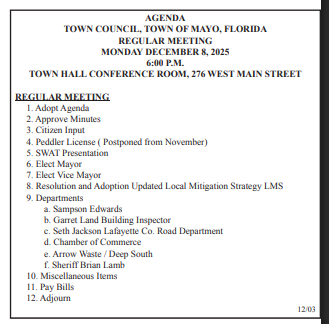
This bureaucratic hurdle effectively barred citizens from participating in a "Citizen Input" session that was clearly listed on the docket, raising concerns about compliance with Florida Statute 286.0114, which mandates that members of the public be given a reasonable opportunity to be heard on a proposition before a board.
Who is Actually Running The Town?
Beyond the meeting room, residents face a digital wall of silence. In an era where information is usually a click away, the Town of Mayo remains largely offline. The official website, townofmayo.org, fails to list current town council members or their contact information, leaving constituents with no direct line to their elected officials.
The lack of updated digital infrastructure extends to general information sources as well; the Mayo Wikipedia page currently lists Ann Murphy as the Mayor, information that is significantly outdated. This digital ghost town makes it nearly impossible for citizens to research who represents them or how to contact them outside of physically visiting the town hall, a barrier that limits accessibility for the working class and elderly.
Gatekeeping the Public Record
The struggle to access basic information appears to be systemic. Citizens asking where they can find meeting agendas are routinely directed to "the newspaper" or told to call the Town Secretary. However, inquiries made by Lafayette County News suggest that this process is far from seamless. When our reporters contacted the Town Secretary, requests for the agenda were denied until after publication by the Riverbend News, with further delays common even after that threshold was met.
Furthermore, Lafayette County News requested to be placed on the news media distribution list to serve as an additional resource for informing the public. This request was denied on the grounds that we were not considered an "established news site." When pressed for the criteria regarding what qualifies as "established," town officials provided no answer.
Minutes Turning into Months
The delay in information flow continues well after the gavel falls. While it is customary for draft meeting minutes to be made available within a reasonable timeframe—typically 7 to 10 business days—to ensure the public stays informed, the Town of Mayo operates on a different schedule.
We were informed that the draft minutes consist of handwritten notes that are often not formalized until a few days before the next monthly meeting. This month-long lag effectively gatekeeps information, preventing the public from reviewing official decisions until the window for immediate reaction or feedback has largely closed. This practice challenges the spirit of Florida's Sunshine Laws, which prioritize open and accessible government.
Will the Cameras Ever Roll?
Perhaps the most visible issue is the lack of visibility itself. As the recent overflow crowd demonstrated, the current meeting room is insufficient to house the number of interested citizens. Yet, despite direct requests from the public to address this access gap, the Town Council does not live stream their meetings.
Today, broadcasting a meeting requires nothing more than a free YouTube channel and a smartphone or laptop—a zero-cost solution embraced by municipalities across Florida to ensure transparency. By failing to adopt this simple technology, the Town of Mayo not only excludes those who cannot physically squeeze into the room or attend due to work or health reasons, but also ignores the explicit wishes of its constituents, leaving many to wonder why the Council is hesitant to let the cameras roll.
A Call for Sunlight in the Sunshine State
As Mayo continues to evolve, the friction between an engaged citizenry and an analog administration is becoming impossible to ignore. Florida is known as the Sunshine State not just for its weather, but for its commitment to open government; yet for the residents of Mayo, that light remains dimmed by bureaucratic red tape and outdated practices. Whether through adopting simple live-streaming technology, digitizing agendas, or simply updating a website, the path forward requires the Town Council to bridge the widening gap between the town and the community it serves. Until those changes are made, citizens—and this publication—will continue to ask the hard questions, waiting for the answers they are legally and ethically owed.